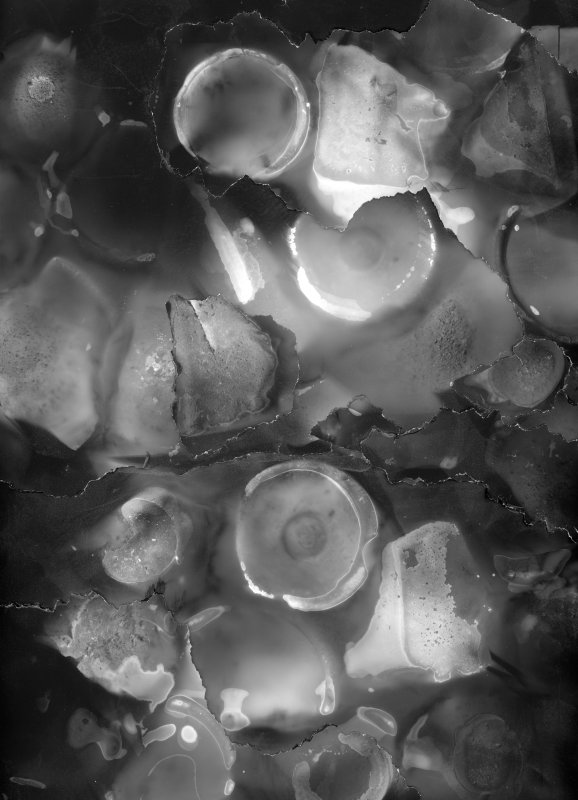
A collage made from photograms using roughened and rounded glass fragments collected from the mud and shingle of the Thames foreshore at Limehouse. I don’t know their age, they look perfectly ordinary to me, no lettering. The circles must be the bottoms of glass bottles. Nothing valuable, nothing like the treasures described in Ted Sandling’s book ‘London in Fragments’, but from that book I take this notion, in Iain Sinclair’s foreword:
’The impulse is forensic: bones, smoothed corners of brick, masonry nails, coins, relics hidden among gravel and coal bruises to tempt future detectorists and amateur historians…. The practice of strolling and snooping, turning over likely stones with boots poulticed in noxious slop, is one of the surviving liberties of the city.’
And here, in his introduction, is Ted Sandling referencing Richard Jefferies. ‘It is the one place where ancient litter outnumbers the contemporary. It is empty, derelict, rotting. There is history, but there is also the future of ‘After London’, Richard Jefferies’ Victorian post-apocalyptic melodrama, with its vision of oozing black swamps covering the city. Underfoot, Jefferies’ prediction holds true. The thick black mud has already swallowed his London, occasionally spitting it out again’.

