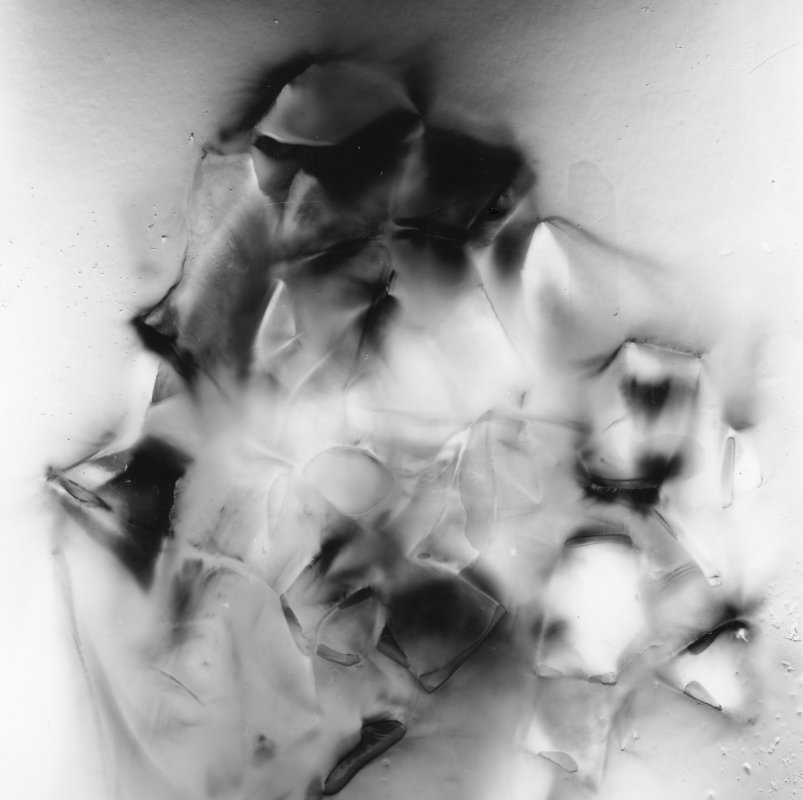
Two months ago I was in San Sebastián, on the northern Spanish coast. I went there to visit Chillida Leku, Eduardo Chillida’s studio and sculpture park, and to stand in front of ‘Comb of the Wind’, his three iron sculptures fixed to the Atlantic sea-cliffs. While I was there, I went to the Museum of Basque Society (San Telmo) which has a small modern art collection. They have a couple of Chillida pieces too, but it was another work that stopped me in my tracks; ‘1983ko Aste Santua’ by Dario Villalba (1939-2018).
It was a collage with strong black and white rough-edged shapes, muted colours and a half-obscured photo of a figure and face. Instantly recognizable, though I’d only seen one of his images before, and that was in 1987, on my first visit to New York. I went to the Guggenheim Museum, and in ignorance of the ‘no cameras’ policy started taking photos of the works that really struck me. One was by Chillida, the first of his sculptures I’d ever seen, and the other was by Villalba; ‘Holy Week 1982’, a very wide piece, multiple broken figures, each one using the same photo and colour range as in San Sebastián.
Two images, that’s all I got before a guard told me to stop, but I’ve kept those two ever since. I followed up Chillida; books, exhibitions (Hayward Gallery 1990) and he became a big favourite. Villalba is less well-known, and I didn’t find out more. I’d only seen that one piece until this September, but I saw it at a time when I’d seen less art and images were scarcer than now, so each one had a greater impact. He must have been an influence, hidden away – black and white collage, fractured imagery, a suggestion of figures and faces…
A footnote: Chillida played in goal for Real Sociedad as a young man. His career as a footballer was ended after one season with a bad knee injury. Villalba represented Spain as a figure skater at the 1956 Winter Olympics (age 16). He was quoted as saying ‘My obsession was not finishing last’. He came 14th out of 16.
 Dave Eva Photograms